
Ask around for software to help with government bids and the same names keep coming up: GovDash, Sweetspot and Chromie on the government-contracting side, Loopio and Responsive from the world of RFP response. We build Offra, which is on that shortlist too, so read this as a comparison written by an interested party. We have tried to make it one you can check. Every claim about another company comes from that company's own website (for Chromie's team size, its Y Combinator profile), read on October 1, 2026, and the pages are listed at the end.
The five are not one kind of tool, and that matters more than any feature list. Three of them start by finding work. Two of them start once the questions are already in front of you. Which kind you need depends less on the software than on who in your firm does the bidding.
Key takeaway: GovDash, Sweetspot and Chromie are capture platforms. They find government work and run the pursuit for firms with a business-development or proposal team, and they sell through a demo. Loopio and Responsive are answer libraries. They fill RFPs and questionnaires from content you have already approved, and neither describes finding bids. Offra is for a firm without a proposal department: it finds federal, state and city notices, helps you decide, reads the package and drafts answers, with a free account and its prices on the website.
Two kinds of tool get called "RFP software"
A public bid is four jobs in a row. You find the notice. You decide whether it is worth bidding. You comply with everything the package demands, which is spread across forms, attachments and amendments. Then you answer: the narrative, the forms, the price. Each tool in this comparison starts at a different point in that line.
Capture platforms start at finding. In government contracting, capture is the work between spotting an opportunity and submitting for it: knowing the buyer, the incumbent and when the contract comes up again. GovDash, Sweetspot and Chromie search SAM.gov and, to different degrees, state and local portals, then carry the pursuit forward into a pipeline and a proposal. They are built for firms that have people whose job is capture.
Answer libraries start at answering. Loopio and Responsive grew up around a different problem: the same questions arriving over and over, in security questionnaires, due-diligence questionnaires and RFPs from companies. You build a library of approved answers once, and the software pulls the right ones into each new questionnaire. Public tenders repeat many of those questions, which is why both now talk about bids and tenders. But a library answers questions it has seen before. It does not find the notice, and a public tender's risk is often not in the questions at all. It is in the mandatory form in an appendix and the bond wording, the things that disqualify a bid before anyone reads the answers.
Most small bidders have neither function. The person bidding is often the owner, an estimator or one or two people doing it alongside the real work. Most of their time goes into finding notices and reading packages, not polishing narrative. That is the firm Offra is built for, and it is the lens for the rest of this comparison.
At a glance
What each tool is built around, in its own words where it has them:
| Built for | Finds open bids | Works on the solicitation | Drafts answers | |
|---|---|---|---|---|
| GovDash | Government contractors: BD, capture, proposals, contracts | SAM.gov, PIEE, SLED and GSA eBuy "in one place" | Capture and proposal modules | Yes |
| Sweetspot | BD, capture and proposal teams "with a history of past performance" | SAM.gov, USAspending, FPDS, DIBBS and "1,000+ state and local sources" | Compliance matrices from a "shred and draft" process | Yes |
| Chromie | Government contractors, federal and SLED | SAM.gov and state, local and education portals | Extracts requirements into a readiness assessment | Not described on its homepage |
| Loopio | Response teams: RFPs, security questionnaires, DDQs | Not a feature it describes | Maps the questions, including from web portals | From your approved library |
| Responsive | Sales and proposal teams: RFPs, security questionnaires | Not a feature it describes | Not described on its homepage | From your approved content |
| Offra | Firms bidding public work without a proposal department | SAM.gov plus state and city boards | A requirement checklist where every line cites its source | On Business, never your price |
And how you buy each one:
| Prices on its site | Free plan | Security claims on its site | |
|---|---|---|---|
| GovDash | No. Plans are listed; "talk to sales for seat prices" | None listed | FedRAMP Moderate Equivalent, C3PAO audited; DFARS 252.204-7012 for CUI |
| Sweetspot | No. The pricing page is a demo form | None listed | CMMC Level 2 and SOC 2 Type II certified; FedRAMP Moderate in progress |
| Chromie | No. "Book a demo" | None listed | None stated |
| Loopio | No. Custom quote; the entry plan includes 10 seats | None listed | SOC 2 Type II, ISO 27001, ISO 42001 |
| Responsive | Entry edition "starting from $10,000"; the rest through sales | None listed | ISO 27001, 27701 and 42001 certified; SOC 2 compliant |
| Offra | Yes, on the pricing page | Yes: no card, no time limit | None held; what we do instead is on the security page |
Both tables come from each vendor's own website, read on October 1, 2026. "None listed" means the site does not mention one, not that it could never exist. Vendors change their plans and pages, and if one of these cells has gone out of date, tell us and we will correct it.
GovDash: the whole lifecycle, for a team that runs capture
GovDash describes itself as "the AI that grows your government revenue". Its modules cover nearly everything a government contractor does: finding opportunities, capture planning, a CRM built for government contracting, pricing, proposals, contract management and reporting. Its search covers SAM.gov, PIEE, SLED and GSA eBuy, and ranks each notice against your past performance. It connects to the tools an established business-development shop already runs: Word, SharePoint, Salesforce, GovWin and more.
Where it is strong. Breadth, and security. GovDash runs past the submission into managing the contract after award. It says it is FedRAMP Moderate Equivalent, audited by a C3PAO, and compliant with DFARS 252.204-7012 for controlled unclassified information (CUI). If your proposals carry CUI, that sentence alone may decide the shortlist.
How you buy it. Annual plans: Starter from one full seat, Growth from eight. Seat prices come from sales. Flex seats carry no seat fee and draw on the team's usage credits.
Where Offra differs. Offra stops where GovDash keeps going: it has no CRM and no contract management. It starts earlier and lower: anyone can search federal, state and city notices on the free account, the prices are on the website, and the paid plans can be bought month to month.
Pick GovDash if you have a capture team, federal work is most of your revenue, your proposals touch CUI, or you want one system from pipeline to contract delivery.
Sweetspot: federal intelligence and proposals, with certifications
Sweetspot calls itself "AI for GovCon, bringing capture, pipeline management, and proposal writing into one secure platform". Its search covers SAM.gov, USAspending, FPDS, DIBBS and "1,000+ state and local sources", and it searches "167M+ federal awards" to find incumbents, partners, competitors and recompetes. It adds monitors that watch vendors, agencies and opportunities, compliance and capability matrices from a "shred and draft" process, and a proposal engine.
Where it is strong. The depth of its federal award search, and the security list: CMMC Level 2 and SOC 2 Type II certified, with FedRAMP Moderate in progress. It is the only tool here that lists CMMC Level 2.
How you buy it. Through a demo. The pricing page carries a booking form and no prices.
Who it is for, in its words: "business development, capture, and proposal teams in government contracting firms with a history of past performance."
Where Offra differs. Offra is built for the firm that may not have that history yet. The free account tells you, on every small-business set-aside, whether you are small under the notice's code, and your first bid runs on the full Business plan for free. Offra holds no certification, so it is not the tool for work that requires one.
Pick Sweetspot if you do defense work where your tools' certifications matter, or award-history research is the centre of your capture process.
Chromie: a new entrant built around capture
Chromie calls itself "the AI operating system for government contracting". It grounds everything in a Company Brain built from your profile, documents and past performance. It monitors SAM.gov and state, local and education portals, and scores each solicitation against your profile. Its recompete intelligence predicts work before it is posted, "with estimated values, predicted post dates, and the program contacts". It extracts a solicitation's requirements into a readiness assessment and tracks each pursuit on a board through to the award.
Its homepage does not describe drafting proposals. It says instead that Chromie "keeps people in the loop and streamlines the work between their decisions".
It is very new. Y Combinator lists it in its Summer 2026 batch, with a team of two. That is not a criticism, since Offra was founded in 2026 too. It does mean the product will change quickly, and this section will date faster than the others.
Pick Chromie if your edge is being early on recompetes, and you want a tool that works beside a capture lead rather than in place of one.
Loopio and Responsive: answer libraries, not bid finders
Loopio describes itself as "Intelligent RFP Response Automation Software". Its AI "pulls the most relevant, vetted answers from your library to instantly populate first drafts". Its portal feature maps the questions on a buyer's web portal into a Loopio project and pushes the answers back, and Loopio says customers have launched projects from over 170 portal providers, such as SAP Ariba, Coupa and Workday.
Responsive, formerly RFPIO, calls itself "the leader in Strategic Response Management & AI RFP software". Its AI "uses your best content, guided by subject-matter experts", across RFPs, security questionnaires and buyer questions. In May 2025 it bought Bidhive, an Australian bid-management platform, which it says enriches its "domain expertise in public-sector bidding and tendering".
Where they are strong. Volume and governance. When the same security questionnaire comes back fifty times a year, a curated library with approval workflows pays for itself. Both list security certifications: SOC 2 Type II, ISO 27001 and ISO 42001 for Loopio, and ISO 27001, 27701 and 42001 for Responsive.
Where they stop on a public tender. Neither product page describes finding open bids, SAM.gov or state portals. A library also needs content to work. A firm bidding its first few tenders has no approved answers yet, and the questions in a public tender are often the easy part. The work is in the requirements around them, which is why a compliance matrix has to be built from the package itself.
How you buy them. Loopio quotes each customer, and its entry plan includes 10 seats. Responsive's entry edition starts from $10,000, and the rest go through sales.
Pick one if you answer a high volume of recurring questionnaires, you have someone whose job is to keep the library current, and public tenders are a minority of what you respond to.
Where Offra fits
Offra is built for a firm that bids public work without a proposal department. It covers the four jobs in order, and it starts free.
Find. Federal notices from SAM.gov sit in one search with state and city boards, including Texas, Virginia, Washington, DC, California and the New York City, Los Angeles and San Francisco boards. The states Offra covers lists every source and the ones coming next. You can search them on the open tenders portal without an account. Each notice gets a plain title, and filters answer the questions a small firm asks first, such as hiding spare-parts buys or leaving out notices that ask for a bond.
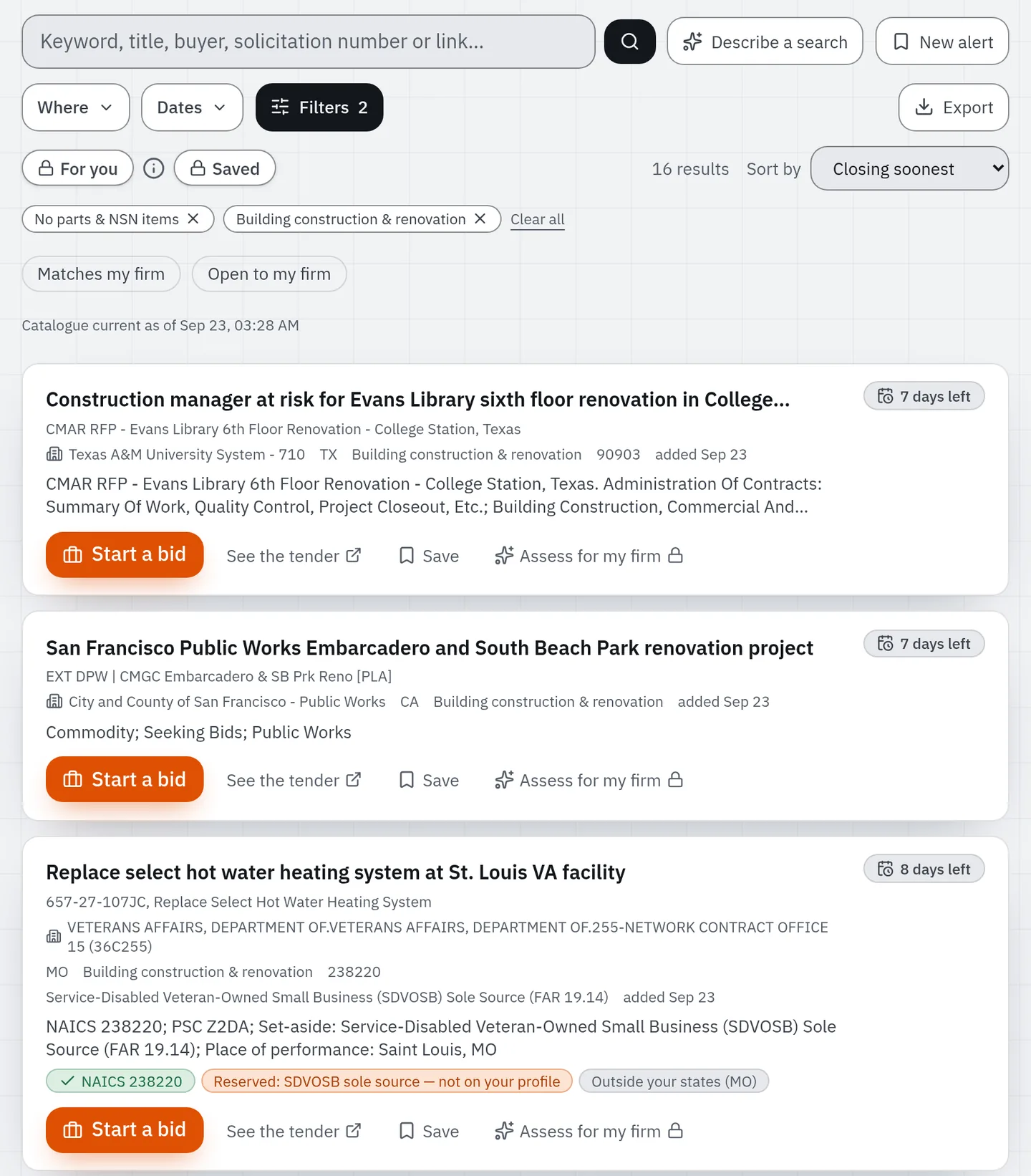
Decide. On the free account, every notice opens on a quick screen that sorts its facts into Can't bid, Check first and In your favour. Once you have entered your size, that includes whether you are small under the notice's NAICS code. An 18-question bid/no-bid checklist comes with every plan. Business adds a go/no-go with a win chance and pricing guidance, and shows who has been winning the buyer's work, read from federal, state and city award records. Making the bid/no-bid call in twenty minutes covers the thinking behind it.
Comply. On a paid plan, and on your free first bid, Offra reads the whole package. It builds a requirement checklist where every line cites the passage it came from, lists the documents you have to produce, and sets out the key dates. On every plan, including the free one, it tells you when a notice you watch changes, down to a SAM.gov attachment replaced in place.
Answer. On Business, Draft answer writes a first draft of a written task from your knowledge base, your company profile and the tender. It leaves a placeholder for anything it cannot know, and it never writes your price.
How you buy it. The free account needs no card and has no time limit. Your first bid runs on the full Business plan at no charge: you add a card, and nothing is charged. Professional and Business are on the pricing page, month-to-month, and you can cancel any time.
What Offra does not do
- It does not run capture past the notice. There is no CRM and no contract management after award.
- It holds no security certification. No SOC 2, no CMMC, no FedRAMP. What it does instead is on the security page: US hosting, workspace isolation enforced by the database, and AI providers that do not train on your documents. If your proposals carry CUI, or a prime asks your tools for a certification, choose a tool that holds one.
- It does not keep a library for security questionnaires or due-diligence questionnaires.
- It does not write your price, and it does not submit your bid. You submit it, on the buyer's own system.
- It does not cover every state. Outside the states it covers, you see the federal feed and little else.
- Drafting and the go/no-go are Business features. Professional reads the package and builds the checklist and the tasks, but does not draft answers.
Which one fits
- You have a capture team, federal work is most of your revenue, and you want one system to contract delivery: GovDash.
- Your proposals carry CUI, or your work is defense: start with GovDash and Sweetspot, and compare what each certifies against what your contracts require.
- Your edge is knowing about a recompete before it posts: GovDash, Sweetspot and Chromie all pitch this.
- You answer the same security questionnaires every week, mostly for companies: Loopio or Responsive.
- You bid federal, state and city work without a proposal department, and want to see the tool on a real notice before talking to anyone: Offra.
If your real comparison is Offra against SAM.gov's own free tools, that has its own post.
How we compared
We read each vendor's own website on October 1, 2026: its homepage, its pricing page and, where there was one, its security page. We did not use review sites, third-party price reports or other vendors' comparison pages. We have not had accounts on these products, so this compares what each says it does. It is not a hands-on test.
- GovDash: homepage and pricing.
- Sweetspot: homepage and pricing.
- Chromie: homepage and its Y Combinator profile.
- Loopio: product, pricing, security and portal response.
- Responsive: homepage, pricing, security and the Bidhive acquisition.
If you work at one of these companies and something here is wrong or out of date, write to us. We will correct it and note the change at the top of this post.
Try it on a notice you already know
Find a notice you are tracking in the open tenders. You don't need an account to look. If it is worth keeping, create the free account from that notice, and Offra opens on it once the account is set up.